Showing posts with label Autism. Show all posts

Sunday, July 26, 2020

Clarity

Every year for the last several years, starting in 2012, I have picked a word and participated in Ali Edwards' One Little Word workshop throughout the year.  This year's word that I have chewed on for 7 months is
For July, I have been sitting with my word almost daily. A question that keeps surfacing: About what am I clear at this point in 2020? I thought I would take some time for a brain dump on my sorely neglected blog.  

It is clear to me:
  • that life is precious
  • that talking about lives affected in terms of percentages is callous
  • that the society I live in (United States) believes it is invincible
  • that hypocrisy is rampant
  • that we are all affected by COVID-19
  • that public opinion changes on a dime
  • that people can amass great amounts of power and have very little sense
  • that schools and their teachers are vital to a well-running economy
  • that children's sports are viewed as more important than protecting children's health
  • that a large portion of US society gets an F in science
  • that critical thinking and discussions are skills that must be instilled in our youth and retaught to our adults
  • that I look through the world with the lens of a white female
  • that I can always make it a priority to understand a different perspective
  • that shutting my mouth and listening is not synonymous to agreeing, and it is helpful for the common good
  • that sometimes people with good intentions make bad decisions 
  • that wide brushes need to be put away
  • that I can't be surprised at how we treat people of all backgrounds when we abort unborn babies and neglect the aging
  • that considering a person's intersectionality helps in understanding his/her view
  • that I need to perpetually think and surround myself with minds that bring up differing perspectives
  • that my definition of summer has non-negotiables
  • that altering the rhythms and seasons of life can have a ripple effect in my emotional health
  • that social media can build up as well as tear down
  • that everyone is doing the best they can with what they have
  • that we need to lean in to delayed gratification
  • that I dislike feeling physically vulnerable because of the non-action of those in charge of my well-being
  • that autism can be lonely when you are a teenager
  • that hiring practices rely heavily on social communication skills that are created through a lens that excludes many
  • that I need to open a school that has alternative "business" hours for kids whose circadian rhythm matches mine
  • that powerful women can intimidate the weak
  • that depression sucks the life out of its victims
  • that the new "normal" stinks, but God has a reason for new pathways
  • that my job as a human is to learn the lessons that this time in history is teaching

That's a whole lot of clarity!

JoLynn


Saturday, June 6, 2015

Explaining Autism

If you follow this blog (apologies for my looooong absence), you know that we have had many blessings, coupled with several challenges, in this life of ours.  One of the challenges is helping our sons navigate the world as they deal with social communications disorders.

We have been upfront about Asperger's, what it means, how it manifests itself, and that my elder son deals with it on a daily basis.  Since he was diagnosed around age 10, we have been openly discussing and naming the disorder.  

My younger son was a different case.  He was only two when diagnosed, and he is a totally different kid with completely different needs.  He was diagnosed with autism disorder (they would both now be considered persons with autism spectrum disorders). We struggled to get him speaking and acclimated to advocating for his needs.  He learns very differently from his brother, and he struggles with the minutiae of the academic world.  It was difficult to determine when we should name why he had the need for sensory, why he struggles with math and reading comprehension, why sometimes kids do not want to play with him, why he repeats, shouts, and the like.  I always felt I would know when to have the conversation.  It never seemed right because he was constantly flipping out if anything about him seemed atypical.  Well, the opportunity did, indeed, present itself.  Now, my son has a name to answer many of his questions.  Autism.

In 2007, I created a scrapbook called "Speak to Me."  The scrapbook was dedicated to Max's journey through the communication struggles he was having.  Max has loved this scrapbook--honestly, he loves all scrapbooks--because it was solely about him.  He also loves that it has buttons to push and a variety of audio recordings from that time.  So, after introducing him to the word "autism," we grabbed the scrapbook (which I made before his diagnosis) and read through what was happening with him at the time.  I cannot tell you how valuable that scrapbook was to this process.  God knew.  He gave it to me as an outlet, then as a guide.
  
Does he "fully" understand the breadth of his ASD?  No.  None of us does.  It's a developmental mystery that is different for each child who is on the spectrum.  However, he almost seemed relieved to have a name for the things about him that he knows are different from the norm.  We will move onward with building his confidence in the many ways he is unique, special, and in some ways, completely typical of any 10 year old boy.  


Thursday, July 4, 2013

Being an American


The Fourth of July is, hands down, my favorite holiday of the year.  It is smack dab in the middle of summer. Many people have off from work (I recall my days in retail when that was not so!).  There are fireworks going off everywhere.  We take a moment to really reflect about our country and what patriotism really means.

I am openly critical of the government in my country because the government is set up to protect my speech.  I am allowed, whether my opinion is deemed "right" or "wrong," to criticize.  That does not mean I am not a staunch supporter of the United States.  The little face up above is why I would not want to live anywhere else.

In the public school system in my country, my son had the opportunity to enroll in school at age 3, as he was presenting developmental delays due to his autism disorder diagnosis.  He was not speaking.  He was not communicating well.  We were working with him, but he needed a jump start.  He was presented with that opportunity.  We slowly but surely progressed through Early Childhood, into Kindergarten, and through Grades 1 and 2.  He made tremendous gains.  He speaks.  He holds conversations.  He can read and write and complete math problems.  He can be a part of a class and, with the help of an aide, merge socially.

While Max's story is kind of a big deal, we have "big deals" happening all over public and private schools in our country.  Teachers who find that magic balance...the pixie dust...that allows a child to bloom at just the right time.  There are other countries who do not have this.  There are other countries where students with disabilities are marginalized and treated as less than they really are.  In the history of our own country, we have come a great distance in the area of teaching the developmentally delayed.

So, on this July 4, 2013, I feel particular pride in our country.  We teach each and every child.  We train teachers to treat children with dignity and respect, despite their backgrounds or abilities.  I am part of this educational system, and I feel fortunate that my children are as well.  With all of the system's flaws, we are definitely doing some things right.

Friday, June 14, 2013

Finality and Fishy Metaphors in ASD-land

Tonight, we went out to celebrate our 21-year wedding anniversary.  We ate out with our kiddos.  Ignatius mentioned something about our first anniversary, and we started discussing what we did.  Scott made a comment about us spending it with a bunch of family who is "all dead" now (meaning several of his aunts).  This sent Max into an unexpected tizzy.

He has been pondering death in his own little way.  First of all, he's 8, so death is not something easily grasped.  Second of all, he has autism, so the idea of us not being 100% sure what happens when we die until we get there is not comforting.  We discuss what we believe, and he seems to "get it" as much as he can.  But then he perseverates on it and gets himself upset all over again.  At the moment, he has a schedule of what life is.  Third grade comes after second.  Fourth after third.  This goes on through high school.  And then you go to college (from his lips to God's ears).  Then you work.  Then you retire. (if you are lucky...but I can't add that, because that is like bombing the apple cart)  Then you die.  Then...um...well, heaven, which is something I cannot really explain sufficiently for his little mind.  He gets that there was "existence" before he was born.  Although he is not pleased that anything existed before him, he gets that we lived in another house without him.  He's finally not jealous of that.  However, just saying, "That was before you were born," does not cut it.

Well, where was he before he was born?  I mean, if Mommy was little, then where was he?  My favorite answer to that is "watching from heaven."  That sort of works out as acceptable.

Such a linear path his little brain has.  He is fascinating to listen to.  And challenging to answer.  But it's all good challenge.  I have to discern what I believe, and then translate it into what makes sense to him.  And we all need to be careful of offhand comments, because he listens to EVERYTHING and chews on it.  For years.  No exaggeration.

Another example, that I call: A Fishy Metaphor.  The first day we had our fish at home, he decided he wanted to give one of them a kiss.  This ended with one of them being MIA, and the others swimming in terror when they saw him.  After the obligatory anger response (despite the fact that I did not want fish...but oh, he'll be fine...yadda yadda) from his dad, Scott tried a "what if..." 

"What if you were in your bedroom and a big hand came in and snatched you up?"

Pause and reflect, won't you?

No, he did not understand this parable.  Yes, he is now terrified a giant hand will come in and snatch him.  Yes, this comment did take us two (thousand) steps back in getting the kid to sleep in his own bed.

Each day since then, my husband tries his hardest to get Max to "understand" what this meant.  As I sit and watch.  And sigh.  And thank God for this man who is trying his very best to co-parent in this weird desert of sand dunes called autism.


Tuesday, April 24, 2012

Autism Awareness Tidbit #17

Stimming is a characteristic of some persons on the spectrum.  This wiki does a nice job of defining and describing stimming.  Many times, stimming will be linked only with the hand and finger motions that sometimes accompany the behaviors of the spectrum.  I like the chart provided on the wiki:

SenseStimming Actions
VisualFlapping hands, blinking and / or moving fingers in front of eyes; staring repetitively at a light
AuditoryMaking vocal sounds; snapping fingers
TactileScratching; rubbing the skin with one's hands or with an external object
VestibularMoving body in rhythmic motion; rocking front and back or side-to-side
TasteLicking body parts; licking an object
SmellSmelling objects or hands; other people

Persons with autism are looking to experience the world in ways a bit different from what is society's norms.  I look at it like this: we all have ways of soothing ourselves.  If the sun bothers my eyes, I wear sunglasses.  If I am scared in a movie, I can grab the arm of the persons accompanying me, or look away until the scariness is over.  When I am in a hammock or rocking chair, I get sleepy because I am relaxed.  The list above are ways that needs are met for perons with ASD.  Both of my boys have had some forms of stimming.  Max's most recent stim reminds me of Mary Katherine Gallagher on SNL.  He smells his hands, especially after touching metal.  This became a little challenge when zipping coats during the winter, opening doors, and wearing jeans.  I have to say, it cracks me up, as I literally have a visual of Molly Shannon flash before my eyes every time he does it.  His brother's issues tended to be more visual and auditory.  Before we new Ignatius was on the spectrum, he would move his fingers in front of his eyes and make noises.  At that point, my best response was, "Dude, you are in public," as he would do it walking in the supermarket.  I was amazingly smooth, eh?

Saturday, April 21, 2012

Autism Awareness Tidbit #16

The days before our wedding were a little stressful, as is true for anyone.  Genius that I am, I got married the day after my last day of school during my first year of teaching.  Epic.

During this time, my hubby and I were going to have his birthday dinner with his out of town relatives.  He parked the car, and we exited.  A woman got out of her car and the following conversation ensued:

WOMAN: I can't back out.

SCOTT and JOLYNN [look at each other, puzzled]: Excuse me?

WOMAN [seemingly more annoyed]: I can't get out!  You parked your car there, and I can't get out.

[Important note: We were in a parking space, as was she.  Our space was perpendicular to hers.  There was LOTS of room.]

SCOTT: Would you like me to back it out for you?

[SCOTT, seeing that this conversation would continue and realizing the peril OUR car was in, moves our car so WOMAN can get out.]

We went to dinner and shared our odd little escapade.  One of Scott's aunts then chimes in with "Oh honey, she might be sick."  Seriously? She was going to side with the woman who clearly should no longer have a licence (or maybe should not have had one ever)?  She's going to add to my wedding stress with a guilt trip? 

Now that I am a little older, I understand her need to be a buzzkill, as it was a funny story to share.  What she was saying was that in situations such as these, you might always be dealing with a person who is "all there."  There could be reasons for their actions or words.

That has stuck with me, particularly when it comes to kids and parents.  Case in point, the young man who just rode his bike ever so slowly in front of my moving automobile on the way out of Arby's drive through.  This was followed closely by the young man who rode his bike slowly across GE at Veteran's (one of the worst intersections in Bloomington-Normal) to go into the Walgreen's lot on a Saturday afternoon.  Both of these gentlemen made some seriously bad choices, but they were seemingly oblivious.  At one point in my life, yelling, sarcasm, and interesting facial expressions would have ensued.  But now, all I could think was, "Does he have something wrong with him?" or "Oh honey, he might be sick," to put it in southern Illinois terms.  Today's tidbit: please consider, when rushing to judgment over the actions some people make, there could be a backstory, like autism, that you may not be considering.  We need to treat everyone like they "might be sick."  The world would be a kinder place.

Wednesday, April 18, 2012

Autism Awareness Tidbit #15

Take a minute to watch this.  Can you imagine how hard these parents and teachers worked to see this day?  And the pride in that room at this moment?  Eyes on the prize.

Monday, April 16, 2012

Autism Awareness Tidbit #14


Persons with autism can do amazing things because they look at like through a completely different sets of eyes.  For today's tidbit, I would like to refer to a previous post of mine from when I first watched Temple Grandin's movie produced through HBO.  It inspired me so much, my license plate (DNL 2) pays tribute.  If you have not seen it, you must.

My previous blog can be found here.

Sunday, April 15, 2012

Autism Awareness Tidbit #13

Inclusion, mainstreaming, whatever you wish to call it. IDEA is Federal legislation that allows students to be instructed in the "least restrictive environment" for learning to occur.  The law was created in the 1980s, with very little thought put in to good professional development for teachers on how this new frontier would work.  It's the idea that, which some modifications and appropriate accommodations, students who traditionally had to be in a separate special education classroom for instruction could be instructed in a general education classroom.    

Educators have a host of opinions on this topic.  What I can say is that I was IN NO WAY ready to teach students with special needs after my undergrad.  All of the training I have has been on-the-job training.  I was told that we would study about "exceptional children," but I probably would only have to deal with gifted students, and not the other end of the spectrum.  

For many years in my career, this was true.  I taught in a Catholic school and we had no students with IEPs.  When I moved to the public sector in 1999, I was in a building where students with IEPs went down to the resource teacher's room throughout the day.  Over the last 10 years, I have changed my practices, I hope for the better, and I do have many students with learning disabilities in my classroom.  I try to differentiate my curriculum to meet the needs of all of my students, but I am BY NO MEANS perfect at this.  It's a huge job, and I am grateful for the people I work with who are willing to team with me to help students.  Still, it's not full inclusion, and some students are not in the gen. ed classroom.

As a mom, navigating the world of gen ed/spec ed for Max has been interesting to say the least.  I adore his first grade teacher and her inclusion efforts.  He has an aide who is shared with a couple other students, and he considers himself to be in her room.  This did not happen in K.  In fact, it was almost the complete opposite.  He was "associated" with his K room, but this year, he is a true member of his gen ed room.  This was my hope for him, but we had to be sure to push for this.  If we had not, I am uncertain whether or not this would be his reality.  This is not a criticism of his teachers or his school by any means.  It is the reality of each special education student needing informed parent advocates.  

A fantastic resource for inclusion and making it work is Paula Kluth.  I was fortunate enough to hear her speak recently as a workshop of hers was hosted by our Regional Office of Education.  She has an abundance of great information and strategies for how students can be successful in the gen ed classroom.  If this is the dream you have for your student, it is achievable, but you must have a gen ed teacher who shares that belief.  My own opinion: if you don't have a flexible gen ed teacher who is willing to learn how to meet the needs of your student in her classroom, I am not so certain your child would be better off in that room.  Some would argue that the child is at least exposed to grade-level material being in there.  However, is that the place where his learning is best served?  Look at the program, the teachers, the aides, and, most centrally, the child himself.  Don't be afraid to buy the teacher a book or two for her summer reading, or sponsor some workshop money for her to get better at meeting the needs of your student.  And have patience that we are so very far from perfect, but most of us teachers are trying pretty hard to meet the needs of every student.

Saturday, April 14, 2012

Autism Awareness Tidbit #12

It has nothing to do with you, and everything to do with us.

We have had the blessing of many, many people offering us support on our parenting walk.  Our families are not in the immediate area, so I am grateful for the amazing network of people who are there for us.  One thing that I think is true of not just parents of children on the spectrum, but parents of children with any sort of special need: Superman/Superwoman complex.

More people than I can count have offered to watch my children over the years when neither Scott nor I could.  Good people.  A select few have watched them.  Why?  Because we are neurotic.  We go through our day navigating this condition our kids have, and, from our perspective, we could not possibly ask someone else to take that on.  And, when we get even an idea that we might want to leave them with someone, the list of 10,000,000 things that they need to know is the first thing that comes to our minds.  So, we juggle.  And we do not date, DESPITE the fact that we KNOW we need to cultivate alone time.  Why?  Well, when everything else takes a bite out of your day, you are too pooped to party.  Heck, you barely even remember each other's names.

It is important to remember, however, that in marriages with even the most stressful situations, your spouse needs the "couple time" that was there BC (before children).  I stink at remembering this, and I am damn lucky I have a husband who puts up with everything else and everyone else seemingly taking priority.  But I need to get better at offering him the time he needs.

My tidbit for tonight: Hearts are warmed by offers to stay with kids with special needs so their parents can get out on occasion.  Keep them coming, but don't be sad if you are not taken up on them.  It's not you.  It's us.

Thursday, April 12, 2012

Autism Tidbit #11

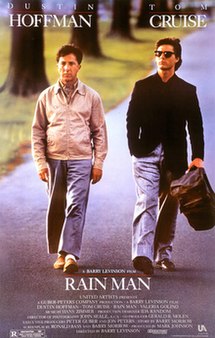
Remember Rain Man?  Dustin Hoffman's portrayal of Raymond Babbitt remains one of the best performances on record.  Now that I deal with perseveration as part of my everyday life, I am convinced that his acting was severely underappreciated at the time.  His repetition of phrases as he played Tom Cruise's brother with autism made many a viewer chuckle.  I still make, "5 minutes to Wapner" comments.  Classic.    There is perseverative behavior in both of our boys.  With Ignatius, it's more his thoughts.  He builds himself up to an anxious state because of the perseveration of thoughts that will not leave him alone.  With Max, it's actions as well as words.  This month, his perseveration is the fire alarm that went off after school one day.  Last month.  And we still hear about it like it was today.  Over and over again.  And while it's cute for a while, it makes us a little nutty sometimes.  Because, if you do not respond, his repetition becomes more urgent.  And if you disagree with what he's repeating (The moon is made of cheese, right Mom?), you open yourself up for a screaming meltdown.  
My brain has responded to this by putting me in almost a stupor.  People can say things to me, and I am completely glazed...I am lost in my happy place.  It's just too much verbal information, over and over.  So, if you know me, and you have to repeat something for me, please know that it is because I am in survival mode and I'll return if given a moment or two. 

Tuesday, April 10, 2012

Autism Awareness Tidbit #10

Persons on the spectrum must manage their sensory needs.  This is easier said than done.  What, exactly, does this mean?  I can describe our perspective on that.

With my older son, sensory input initially took the form of oral needs.  Everything went in to his mouth and was chewed on.  Everything.  He sucked his two middle finders until he was about 4.  He chews on pencaps until they are unrecognizable.  He also had what one might call a "stim" phase: he would flick and manipulate his hands and fingers on a regular basis.  This was usually accompanied by some sort of vocal noises, sometimes reenacting a video game he had played, sometimes just an outreach of a vivid imagination.  Most of the time, he must fidget with something in his hands.  Shoe string, his ear, whatever is sitting around.  He was also VERY sensitive to loud abrupt noises.  He would run away screaming if an ambulance or something like that drove by, just as much as if a book suddenly dropped to the floor.  He has learned to cope with this.

With my younger son, the sensory input comes in the form of pressure.  When he was a toddler, he banged his head on the floor to the point of bruising and lumps.  He would also head butt us, which could cause a nosebleed or two if we were not on the lookout.  He also liked (likes?) to heavily jump on the sidewalk from a step without shoes on.  He also enjoys jumping from a bed to the floor for the same sensory input.  He likes to apply pressure with his hand on a person's head as a symbol of endearment.  (It's often the way he says good bye to me in the morning.)  Like his brother, he likes repetitive movements and noises, often reenacting something he's seen.  There is a sensory room in his school where he can go if the regular classroom becomes overstimulating (sensory overload).  This can happen at events like school parties, when structure is at a low.  The sensory room has a variety of items: a swing, a mini trampoline, and, quite frankly, just a place to get away from the crowd.

Sensory overstimulation is the main reason why people should be cautious about touching persons on the spectrum.  For some individuals, it is as painful as a thousand pinpricks, even if the intention is a hug or a pat on the back.  Auditory overstimulation is also a challenge.  If too many noises are going on in one place at one time, a person on the spectrum can have a difficult time processes all of these.  I liken it to an assault in the senses similar to if a neurotypical person would attend a rock concert.

Monday, April 9, 2012

Autism Awareness Tidbit #9

What's a social story?  And why is it important?

Here's the master, Carol Gray, herself, speaking of her creation:


I use the term "social stories" similar to the term "kleenex."  Not every tissue is a Kleenex brand tissue.  Not every predicting conversation with students is a Social Story as defined by Gray. I do my best as mom and general education teacher to navigate these waters.

My first experience with social stories came when I saw it mentioned on an IEP for a sixth grader with Asperger's Syndrome.  He needed a social story for how to appropriately behave in the lunchroom when eating. This was a highly sensory time for him (a tidbit for another day), and he had the tendency to wear his lunch all over his face.  He needed to know what was socially acceptable at lunch.  Skills like these--ones that neurotypical children just pick up from experiencing them or being told once or twice about them by adults or peers--must be explicitly taught to children on the spectrum, preferably before the child is in the situation.  However, as the video indicates, research beforehand is important.  I might think a social story is needed in a situation, when, in fact, it may not be.

Here's an example.  Let's say a school is planning a fire drill.  A student with autism disorder will need to successfully evacuate the building and return safely, following the school procedures.  An adult would go over a social story with the student, preferably one in writing with accompanying pictures that can then be sent home so parents can review it the night before.  It might go something like this (I am not an expert at these, so bear with me).

Tomorrow we will be having a fire drill.  The fire drill alarm will go off.  It will be a loud noise.  It is OK to put my hands over my ears if the noise hurts them.  It is not OK to scream.  I may talk only to an adult if I have an important question about safety.  When the alarm sounds, I will walk in line with my class to our place on the parking lot.  We will wait in line quietly.  When Mr. Belding says we should return, I will quietly walk in line and return to the building.

These steps are best accompanied with pictures, either using Boardmaker software or actual photos taken at the school, that help familiarize the student with appropriate steps.  The ultimate preparation would include an aide or teacher walking the student through the steps of the drill.

The student mentioned earlier benefited from pictures of him successfully eating in the lunchroom.  Each successful step was documented via digital camera and printed for him in sequence.  It is also important that the critical adults/peers involved in the social story practice with the child if at all possible.  At the very least, they need to know what is in place for the child.

When Max entered Kindergarten, his teachers sent us a bound social story of what to expect and important people's pictures and names.  He read that a lot before going to his new school in August.  Also, his LBS1 and speech pathologist set up a social story for him when he was giving his dad and me a hard time going to school in the morning.  It was very helpful, especially when the schedule changes for a "late start" day.  The McLean County Autism Society provided a social story to accompany their soccer practices.

This works well for children who have difficulty with transitions, regardless of the diagnosis.  For example, a child having a hard transition in to a new grade level would strongly benefit from a social story.  A child with severe anxiety about new places and things would benefit as well.  Kids with separation anxiety can benefit from knowing when, exactly, they will be reunited with their loved one.  It's a fairly useful tool for most parents/caregivers to have.

Sunday, April 8, 2012

Autism Awareness Tidbit #8

My faith has been core to me as I journey the waters of autism spectrum disorders.  I truly do believe that God put my sons into my life for a reason, as any parent can probably attest to about their children.  So, why did he flavor our life with autism?  I'm not afraid to say that I don't have a solid answer to that.  I could sit around and ponder, "Why me?  Why us?  Why my kids?"  It really goes against my grain, as it seems to get me nowhere, and I like to be moving on from things that are difficult.  It's the journey we have the privilege to be on.  Sometimes it stinks, sometimes it doesn't.  But it is what it is and hardships and challenges have existed since the dawn of time.

So, today, on this Easter Sunday, the highest holy day of the Catholic Church, I am thankful to God.  As I am sacrificing my sons, albeit not-so-willingly, to this disorder, he sacrificed his son to save us all.  The light is bright at the end of this tunnel.  He only asks that we enjoy the ride.

Saturday, April 7, 2012

Autism Awareness Tidbit #7

Today's tidbit: You just never know.

With a person on the spectrum, he can appear that he is not listening, when, in fact, he has heard your every word.

With a person on the spectrum, he can be not making eye contact, but is not trying to be disrespectful.

With a person on the spectrum, situations can seem like they will be "too much" for him, but with the right preparation and a little patience, he will do just fine.

With a person on the spectrum, he can appear to be rude, when in fact he is communicating in a way that makes sense to him.

With a person on the spectrum, everything has potential: a pencil, a pen, a crayon, a piece of paper, a tissue box, a shoe, a piece of floor mat--anything can be brought into his world and can be made into what he needs.

Thanks to persons on the spectrum for, among many things, lightbulbs, electricity, and this computer on which I am typing and the Internet that allows me to share it.  Thanks to people who can focus that intensely on one thing to bring it as close to perfection as possible.

Friday, April 6, 2012

Autism Tidbit #6

Today I would like to focus on the blessings that are associated with autism spectrum disorders.

Everyday celebration: There are so many very important things neurotypical kids do, things that my first son did, that I took for granted.  When they happen with Max, I truly celebrate it.  An example: when he finally started "using his words" because he could use his words.  A simple, "May I please have some milk?" still makes me more profoundly happy than a normal person should be.

Reading: Son #1 was reading at age 3.  No joke.  Son #2 struggles at age 7, still teetering between what you should sound out and what should be a sight word.  (I know some of you reading this who have a struggling reader are nodding your heads, even if your child is not on the spectrum.)  For a kid on the spectrum, a kid who needs, in general, an established set of consistent rules, the English language is a little bit torturous.  So, when he reads words or abbreviations of any kind, I am a pretty thrilled mama.

Face time: Max loves to be right in my face.  And I mean RIGHT in my face.  He then places his little hand on my forehead, and applies pressure.  Or he looks straight into my eyes and smiles.  I do not care how it looks to anyone else.  I know that I am lucky to get affection, as one of the traits of ASD is that persons around them are not the objects of affection.  You take affection where you can get it.  Most of the "issue" is not that they do not love their families...there is so much love inside.  Many kids with ASD have so many sensory issues that the typical ways of showing affection, particularly hugs, do not feel pleasant to them.  Sometimes, Max does not want to be touched at all.  Most times, we allow him to initiate the touch that is OK at the time.

Simple pleasures: My kids have been so easy to please.  Both of them are content with paper and a pencil.  Drawing, cutting, using their imaginations.  Thank goodness, they do not need the next new thing, they are not hooked on certain brands of things or shows.  That is a relief.  The only time it is challenging is when someone wants to get them gifts for their birthdays or Christmas.  I truly draw a blank.  Um, paper?

Repetition: Is there Mac and Cheese in the cupboard?  Are there French toast sticks in the freezer?  OK.  We're in good shape.  It really is that easy.  And they are healthy enough...even if I am not holding them down and shoving broccoli down their throats.  It's all good...and predictable.


So very nice: Ignatius,son #1, is one of those genuinely nice souls.  I really mean that.  We spoke at dinner tonight about seeing one of his grade school bullies while at church today.  (Side note: Man, is that hard or what?  There you are, in church, wishing for someone's head to explode...)  Ignatius said, "You know, maybe it was not him.  Maybe it was me."  Really?  Dude.  He also misses the subtleties in social situations that those of us that are more savvy see.  Like when girls are being catty and mean.  Or when boys are being, well, I shall not say that here.  He misses it.  Almost entirely.  And isn't that actually a gift?

Perspective: I think the best part of being the mom of boys with ASD is that I can see things from that point of view.  I am a completely different teacher because of it.  I get to be a person who needs to find different ways to do different things so that a kid can "get" it.  I'm not at all perfect at it, but I am so much better--more conscious--than I used to be.

Support system: Lastly tonight, I have to say that my biggest blessing is my support system.  My family and my friends are an amazing, eclectic group of people.  If Scott and I were going this alone, I do not know what we would do.  And, as many people as wish to damn Facebook, I must say that I am REALLY grateful for social media.  I have realized how many of my friends, with whom I had lost contact, are raising kids with special needs just like I am.  I am learning so much from them.  Mainly that we are not alone, and somebody out there gets it.

Thursday, April 5, 2012

Autism Awareness Tidbit #5

As parents, we have all dreamed our dreams of what our child's lives will be.  Most of us think back to our own childhood and life in school and presume that our child's life will follow in a similar fashion.  If you have a neurotypical child, that will probably be the case, with the exception of the explosion of technology that somewhat alters his/her experiences from our own.

If your child has special needs, you have landed in foreign territory.  What you need to know is, despite its sun-shiny cheeriness, despite the perfect bulletin boards and the smiley face posters, and despite the multitude of activities organized by a PTA, school is going to be somewhat hostile territory for you and your child.  I do not say this to scare or even to criticize.  It is what it is.  It does not mean people will be mean to you or your child.  It does not mean you have to be fearful.  What it means is, as a parent, you MUST be your child's advocate.  No one else has YOUR child's best interest at heart.  The law pretends to.  A law comes to life only in the hands of those who follow it.  Public districts have mountains of laws, especially in the field of children who struggle, under which they must not suffocate.  Bottom line: districts will set things up to do the minimum of what the law requires.  However, what every parent of children with special needs should know is that the law requires that they do EVERYTHING they can do for your child.  Here are a few sites that are helpful for parents to know their rights under the law.  


Wednesday, April 4, 2012

Autism Awareness Tidbit #4

Today's tidbit: Every child with ASD is completely unique.  There are many similarities with the condition across its spectrum.  With each unique child come unique parental responses.  Two examples come to mind: TV shows and support groups.

Well-meaning folk will tell you every show they watched that had anything to to with autism.  I know some people who LOVE the series Parenthood.  I watched the first season.  Beautifully and realistically written.  In order to emotionally survive, however, I could not invest in it.  Other parents of children with ASD love the show.  The show hits different people different ways.  When you HAVE a son named Max and you get him diagnosed...when you have to admit to friends and family that there's something wrong with your kid...watching the reenactment of that is not always a good time.  I am grateful that the show is getting a perspective across that is not always known to the general public.  It also took me some time to warm up to The Big Bang Theory.  At least that is a comedy.  We watch Sheldon, and we find in that actor comedic genius.  Not everyone sees their own son.  I joke that I live with Sheldon.  So many levels of that are not a joke.  Sheldon demonstrates the caricature of Asperger's.  It took me a bit to warm up the fact that America was getting a good laugh out of it.

Parent responses to support groups are another thing that is as unique as the child itself.  I was thrilled that there were support groups in my community.  My local society is fantastic and very active.  I am just at a point in my life where I feel like I am wading in the waters... I don't want to talk about being happy as I drown, or lucky to be in such nice cool water.  Because I am not one bit happy about autism.  I love my children, but I do not love this disease.  I get to watch as other children without it merge into social situations without a problem.  I get to hear about people who never have to think 10 steps ahead to prepare their children for life's unexpected stuff.  Yeah, I know.  There are other things that could be worse.  Yup, I got it.  But I still get to say that I am not OK with my kids being on the spectrum, and I don't necessarily want to sit and talk about it or be reminded of it more than I must.  My attitude shocks me as much as anyone.  I figured out not too long ago that everyone must choose their survival path.  We all have the same 24 hours to live...we all have to accept a certain mindset in order to do it.  I don't have to embrace things as other parents of children with ASD do.

Tuesday, April 3, 2012

Autism Awareness Tidbit #3

How do you know?  All this talk about autism spectrum disorders.  How do you know if a child should go through the steps for diagnosis?

As mentioned yesterday, our son missed a major developmental milestone--putting words together to make meaning and assigning words to objects.  We honestly did not notice right away.  It was when I picked him up from day care and his peers were saying, "Max's mommy," and pointing at me that I realized we were at least dealing with a speech/language delay.  At that point, autism had not entered my thoughts.  Sparing you our own story for now, I will say that bits and pieces came together.  Our major awakening came via the video glossary we found on the Autism Speaks website that compare typical and atypical behaviors at certain developmental markers.  There are also many lists of behaviors that give an initial idea of whether or not to pursue further data gathering.  I avoid saying to "pursue a diagnosis," because, honestly, hearing , "Yes, I am seeing that he is on the spectrum," is similar to hitting a brick wall at 70 mph.  It's not what you want to hear, and you want someone to say, "Will you just chill out?  Your kid's going to be fine.  You are over worrying."

This site is extensive in discussing symptoms of ASD and the road to diagnosis.  There are countless others as well.  If you are really considering an evaluation, your local Easter Seals is also an excellent place to start.  Do NOT rely on your pediatrician.  Rely on your GUT as your child's parent.  Our pediatrician has sinced apologized for missing the diagnosis.  We, as his parents, pushed for a developmental pediatrician screening which led to the diagnosis.  For our son with Asperger's, we were told that kids who are "that smart" just sometimes are that way (having debilitating panic attacks, claiming to hear voices) because they understand things above their biological level and don't know what to do with it.  Our first son grew up in a school system and medical community that truly did not know to suggest Asperger's, and was in no way ready to assist a person with that disability. But that's a tidbit for a whole other day!

Monday, April 2, 2012

Autism Awareness Tidbit #2

The Center for Disease Control and Prevention (CDC) continually studies increases in incidences of certain conditions.  Recently, the CDC came out with the following statistic based on their recent research: 1 in 88 children  (1 in 54 boys and 1 in 252 girls)  has been diagnosed with some form of ASD.  More specifics, along with the study, can be found on this site.

Some meaningful persons have likened this increase to that of ADD/ADHD.  Granted, the ADD/ADHD diagnosis has exploded during the last two decades.  There are critical differences in the procedures for the  diagnosis of each of these.  I have had students go to their pediatrician in one afternoon and come out with an ADHD diagnosis and a prescription.  It took me almost a year for both of my sons to get their diagnoses.  We filled out HOURS of paperwork, and they underwent extensive observation and testing.  Sometimes, ASD diagnoses are missed because pediatricians will jump too quickly to ADHD.  

Unlike ADHD, there is not a drug that one can take to "control" ASD (although, parents of children with ADHD might admit that the medications--and their side effects-- are no miracle cure).  Typically, children undergo a variety of therapies for behavior modification.  

Because early intervention through therapy has shown a great deal of success in children "merging" into society a bit more successfully, it is best to determine the diagnosis as early as possible.  We realized something was wrong with Max when he was not speaking at around 15 months.  As heartbreaking as it was to realize there was something significantly wrong with my toddler, we put aside the sucker punch life handed us and got him the help he needed.  I stand firm that he would not be speaking or interacting as well as he is today as a first grader had we waited on our suspicions.  The pediatrician was looking for medical causes of his symptoms.  We researched and talked with others, and we realized this was much bigger that fluid in his ears.

So why such an increase in children with ASD?  My theories: 
  • the definition of autism became wider when it was expanded to be a spectrum of disorders, therefore, some autistic behaviors that existed in children were missed
  • a generation of parents went undiagnosed and now are having children on the spectrum
  • there is a genetic link to ASD and parents can carry the gene but not have autism themselves